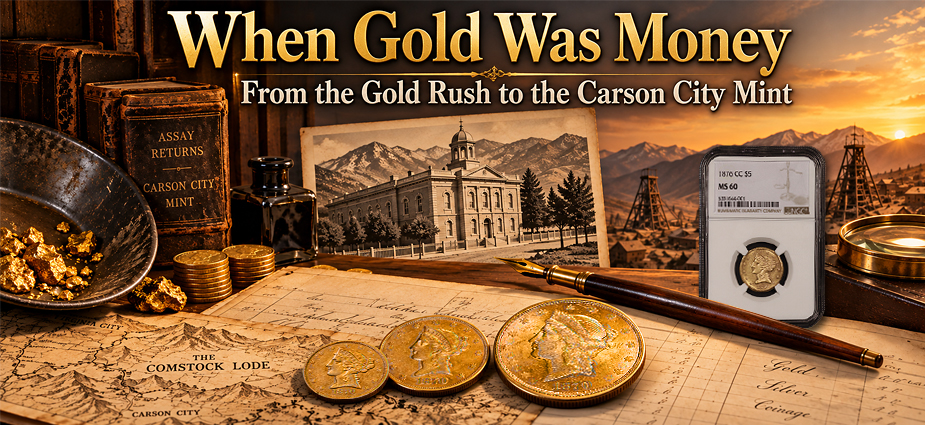
From the Gold Rush to the Carson City Mint
When gold was discovered in California in 1848, few could have imagined how dramatically it would change the American West. Thousands headed west in search of fortune, mining camps became towns, new businesses appeared almost overnight, and enormous quantities of precious metal entered the American economy.
The California Gold Rush also sent prospectors beyond California, following rivers and crossing mountain ranges in search of the next great discovery. That search would eventually help lead them to something else: silver.
Searching for Gold, Finding the Comstock
During the 1850s, prospectors worked streams and canyons along the eastern Sierra Nevada in what was then western Utah Territory. They were looking primarily for gold, but miners also encountered a heavy, dark material mixed with the gold bearing deposits. Initially an inconvenience, it eventually helped reveal something far more important beneath the mountains.
In 1859, discoveries near present day Virginia City led to the development of the Comstock Lode, one of the most important deposits of silver and gold ever discovered in the United States.
In a sense, the road to Carson City’s great silver history began with men looking for gold.
The Comstock transformed the region. Mining operations expanded, communities grew, and Nevada achieved statehood in 1864. Much of the wealth generated by the Comstock flowed west to San Francisco, helping finance banks, businesses and construction and contributing significantly to the city’s growth.
But all that gold and silver presented another problem. What were they going to do with it?
Turning Nevada’s Gold and Silver Into Money
Precious metal from the western mines needed to be refined, assayed and ultimately turned into money. Transporting large quantities of gold and silver over great distances was expensive, difficult and dangerous.
The federal government had already responded to the California Gold Rush by establishing a branch mint in San Francisco. With the development of the Comstock, there was a strong argument for another mint closer to Nevada’s mines.
Congress authorized a United States Branch Mint at Carson City in 1863, and the Carson City Mint began producing coins in 1870. Over its years of coin production, the Carson City Mint struck an extraordinary range of denominations:
- Dimes,
- Twenty Cent Pieces,
- Quarters,
- Half Dollars,
- Seated Liberty Dollars,
- Trade Dollars,
- Morgan Dollars,
- $5 Half Eagles,
- $10 Eagles,
- $20 Double Eagles.
Today, the letters CC are most closely associated with the Morgan silver dollar. But silver dollars tell only part of the story… Gold was there from the beginning.
Gold Coins From Carson City
During its first year of operation, the Carson City Mint struck three gold denominations: the $5 Half Eagle, $10 Eagle and $20 Double Eagle.
These were not commemoratives celebrating the West. They were money. A Carson City Double Eagle contained nearly an ounce of gold and represented twenty dollars at a time when that amount had substantial purchasing power. Gold coins circulated, were deposited in banks, shipped in payment of debts and stored as wealth.
Carson City continued producing gold coins during much of its operating history, often in relatively small numbers compared with larger U.S. mints.
While the CC Morgan dollar may be more familiar today, Carson City gold tells another side of the same story. These coins connect the mining camps, the Comstock and the growth of Nevada directly to America’s monetary history.
In Part Two of When Gold Was Money, we’ll look at how the stories of gold and silver became intertwined in the American West, explore the gold coins Americans actually used as money, and see why the surviving coins continue to fascinate collectors today.